

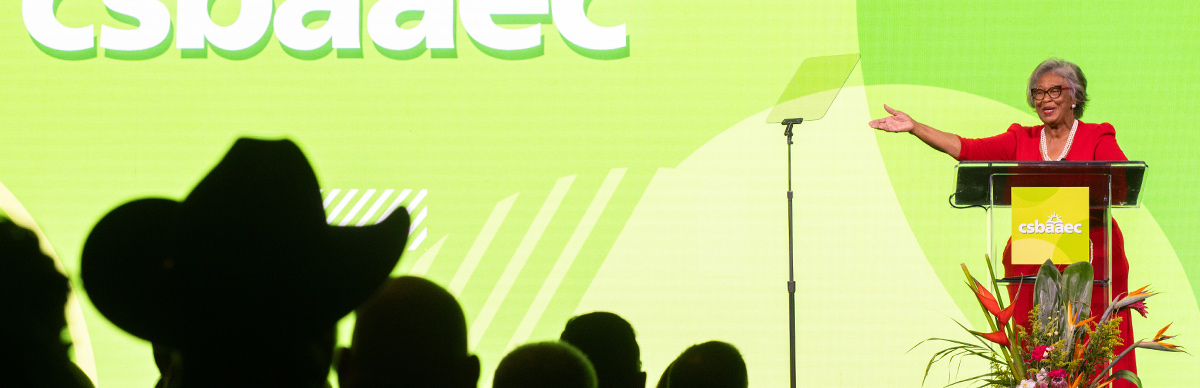
During the first day of the event, CEO & Executive Director Vernon M. Billy introduced attendees to CSBA’s campaign for a state-level operations plan that better supports local educational agencies in their work in closing the achievement gap and provides clear goals, benchmarks and reporting mechanisms to allow policymakers and the public to evaluate the effectiveness of state efforts to accelerate student performance. Learn more about the campaign on page 11 and by visiting csba.org/closethegap.
2025 President Dr. Bettye Lusk spoke about the impact trustees can have on generations of young people through efforts like CSBA’s initiative.
“There are moments in history where we must take a stand against the inequities that are barriers to the success of every child. These are those times. So, let’s move forward with inspiration in our minds and hearts, ready to ensure brighter futures for the students we serve,” Lusk said. “The real question is: What role will you play? Will you stand up and speak out? As governance team members, we must do all we can to establish a system that will ensure the success of every child in our districts and counties.”
The panel focused on crucial education issues including student performance, the achievement gap, state accountability, education funding, teacher shortages, local governance, attendance, declining enrollment, small and rural school districts, unfunded mandates and more.
The candidates that participated were: Riverside County Sheriff Chad Bianco, Former Assembly Majority Leader Ian Calderon, State Superintendent of Public Instruction Tony Thurmond, former Los Angeles Mayor Antonio Villaraigosa and former California State Controller Betty Yee.
Each was asked to assess the state of student achievement in California and how they would address achievement gaps should they be elected governor. The following are summaries of candidates’ responses and do not reflect their full statements.
Bianco stated that “our education system is broken” because “of policies and bureaucrats that are ruining our children’s lives.” “We have been doing it wrong and the numbers show that … We absolutely must change the way we do things to fix the achievement gap,” Bianco said, adding that proven strategies to improve proficiency in core subjects should be used. He said that local control and letting “our educators educate our kids” are important.
Calderon shared his experiences working with his daughter’s school to help improve her reading, highlighting the importance of parental involvement and working together. A legislator when the Local Control Funding Formula was passed, he said it’s made a difference, but that funding hasn’t kept up. He acknowledged the burden of unfunded mandates on LEAs and said the state lacks accountability measures for itself and that the state should work with LEA leaders and hear their perspectives to close gaps.
Thurmond said conversations about closing the achievement gap have been taking place his whole life, but that in his perspective, students can achieve when barriers are removed and opportunities are provided. If elected, he said he’d lead a five-year plan to ensure students can read by third grade, and implement programs based in the science of reading and address issues related to chronic absenteeism and funding, including the potential of enrollment-based funding instead of attendance-based.
Villaraigosa noted that California’s per-pupil spending could be better. He said that while many accountability measures are in place for LEAs, there is little accountability for the state. In what he referred to as a “knowledge economy,” Villaraigosa said that students aren’t being educated as they should and said that some student groups are disproportionately impacted. He said he’d draw on his experiences as mayor where he placed great value in public schools.
Yee observed that student achievement is on the decline and that it should be discussed as a state. She said it must be acknowledged to “put the strategies together that are going to make a difference.” She added that the local perspective on what works for students is needed to inform state policy and that partnership, stable funding, flexibility and ways to measure progress will be key.
After a little over a minute of moving around to other groups of people and engaging with one another, the room was buzzing with positivity.
“Do you feel how the energy in the room just changed? Do you feel how we went from 3,000 individuals to one group?” Lehrman asked as the audience settled in. “I want you to compare that to the ritual of starting a school board meeting. The typical conventional approach is to begin with the Pledge of Allegiance.”
Lehrman focused on a particular word in the pledge: indivisible. “That’s the word that does the heavy lifting,” he said. “It’s the one that says, ‘We may disagree on a whole lot of things, but at the end of the day, we’re indivisible.’”
Known for creating space where people feel heard and respected, Lehrman’s goal is to help governing bodies and leadership teams confront conflict, bridge differences and move from disagreement to constructive action.
“Disagreement isn’t failure. It shows that people care, that your leadership has the power to make us all a little more indivisible,” he said.
However, bringing people together in these tumultuous times can be incredibly difficult in some communities split by seemingly insurmountable divides. That’s why it is so important to make earnest attempts at listening to one another.
It takes “courage to listen to someone with whom you might disagree, perhaps even vehemently, and instead of dismissing them, to say the words, ‘Tell me more. Help me understand where you’re coming from. Help me understand what … makes you see this issue in that way,’” Lehrman said. “It is not a promise that we’re going to agree. It’s a gesture. It’s an invitation to dialogue.
“Disagreement isn’t just natural, it’s necessary,” he continued. “[Boards] sit and talk about these things together publicly so that everyone watching knows that these earnest, intelligent, well-intentioned people are doing their best to figure out what is in the best interests of our community overall.”
Lehrman said that, ultimately, the job of a school board leader focuses on three things: ensuring schools educate all learners, that teachers are equipped to do that job, and that the community is engaged in decision-making.
The purpose of local government is to enable individuals to join together in recognizing and solving community problems, he said.
“I want you to remember that your job as a facilitator in your community is that democracy runs on dialogue,” Lehrman said in closing. “You can’t stop people from having whatever obstinate opinions they have — they are allowed to have their opinions. What they’re not allowed to do is stop the process of governing, and your process of governing is paramount: bringing people together to recognize and solve community problems. Democracy runs on dialogue. Your job is to keep that dialogue going forward.”

“The purpose of education is to help young people learn how to think, not just what to think,” Chowdhury said. She spoke of the importance of the “human in the loop,” who is not just there to monitor AI, but to evaluate the systems and is empowered to make decisions based on human logic without fear of punishment. “If we don’t design systems that allow people to question and act without punishment, we’re not actually supporting human flourishing,” she said.
Chowdhury talked about common myths surrounding AI and said that narratives that AI will eliminate most human jobs eventually are exaggerated. She also cautioned against the more optimistic thinking that AI can be used to level the playing field in education between privileged and historically underserved learners. According to Chowdhury, the evidence does not support either claim.
“At the end of the day, AI does not make sure a child’s stomach is full. AI does not make sure that they come from a stable household,” Chowdhury said. “And these are the things that impact education even more. So one of my concerns is that this narrative of AI being this magical tool that will solve every problem will actually lead to less focus on the things that really matter when it comes to young people, especially disadvantaged young people — ensuring that the education that they get is going to put them on a good path forward in life.”
Drawing on multiple studies, she highlighted serious risks of unstructured AI use in education. One study of graduate math students found that unrestricted AI access led to lower knowledge retention, reduced motivation and widened inequalities. Students often substituted AI for learning rather than using it as a supplement, resulting in what researchers call “cognitive offloading” — the loss of critical thinking through overreliance on machines. Particularly concerning, lower-performing students became overconfident, unaware of how much they had failed to learn.
However, Chowdhury emphasized that AI can be beneficial when used correctly. Research shows that a “mastery approach”— where students critique, verify and build upon AI-generated content — improves learning outcomes, autonomy and critical thinking. “AI should be a scaffold, not a shortcut,” she explained. “It should help students reach the next learning goal faster, not replace the thinking required to get there.”
She then turned to the workplace. While AI will affect many roles, large-scale economic studies suggest it will automate only a small percentage of total jobs. Rather than eliminating work, AI changes how work is done — often accelerating pace and increasing complexity. Importantly, workplace studies show that AI enhances performance most when used by skilled professionals and collaborative teams. “Expertise, human judgment and interpersonal skills remain essential,” she said.
Chowdhury concluded by distinguishing between “techno-solutionism” and “techno-optimism.” The former promises that AI will fix everything if humans simply step aside. The latter recognizes that AI can improve lives — “but only if humans intentionally design systems that promote equity, learning and critical thinking,” Chowdhury concluded.
At the forum, attendees heard directly from candidates about their priorities, policy goals and perspectives on the challenges facing public schools — helping governance teams understand how they intend to support students and strengthen local decision-making.
Participating candidates included San Diego Unified School District trustee Richard Barrera, Los Angeles Community College District trustee Nichelle Henderson, Assemblymember Al Muratsuchi, former state Sen. Josh Newman, former Assembly Speaker Anthony Rendon and Chino Valley USD trustee Sonja Shaw.


