

General session speakers included White House Domestic Policy Advisor Neera Tanden and U.S. Deputy Education Secretary and former San Diego Unified School District Superintendent Cindy Marten on federal education policy updates from the Biden Administration; U.S. Department of Agriculture Acting Under Secretary Kumar Chandran on school meals; Education Week Assistant Editor Alyson Klein on artificial intelligence (AI) in education; Lake Research Partners Founder Celinda Lake; and K12Counsel, LLC Founder Francisco M. Negron Jr. The sessions provided governing board members with an opportunity to engage directly with key federal policymakers and experts, highlighting issues specific to California public schools.
Albert Gonzalez, CSBA President
After acknowledging the hard work of education leaders in California, Marten spoke about the Education Department’s Raise the Bar, Lead the World initiative, a call to action to transform education and unite around what works, based on decades of experience and research, to advance educational equity and excellence.
During the All-Delegation luncheon, Tanden described the strategies the Raise the Bar initiative is using to improve academic performance including a focus on attendance, high-dosage tutoring and extending learning beyond the school day.
“Our focus is ensuring students are learning at least on grade level, at every grade,” she said. “The first strategy is really focused on chronic absenteeism. And honestly, we really do think in some ways we’re in a race against time. We know a lot of students and families got separated from schools during the pandemic and we have to double our focus of re-establishing that connection. Data shows that after the pandemic, absenteeism accounted for up to 27 percent of tests score declines in math, and up to 45 percent of tests score declines in reading.”
Pollster Lake outlined current statistics related to the upcoming presidential election as well as national and California-centric polling results on education issues.
Nationwide, 48 percent of voters think the quality of education in K-12 public schools has gotten worse, but 44 percent think it has improved or stayed about the same, with parents leaning more positively. A majority of voters nationally and in California say public schools are doing a just fair/poor job at ensuring student and teacher safety, teacher pay, providing mental health and other support services, and reducing class sizes. Expanding broadband internet access is the only education-related issue that receives a net-positive rating.

Neera Tanden, director of the U.S. Domestic Policy Council, discusses the Raise the Bar initiative
Voters were split in their worry about people or parents protesting about the curriculum in their community. While half would not be worried about new policies that require parental notification about lessons on gender and sexuality, small margins would not be worried to learn about policies related to restricting LGBTQ lessons or requiring transgender students to use bathrooms or play sports aligned with their sex at birth.
“I want you to know that when you go to the Hill … you are setting the agenda far beyond just your state,” Lake told the crowd. “You really are leading the nation, and there’s so much going on that really needs your kind of wisdom and leadership.”
Following the final general session on April 9, attendees met with their advocacy groups for a strategy session to prepare for their April 10 meetings on the Hill. In addition to drawing on their local experiences, the content from the sessions and talking points ensured members were able to advocate effectively on the core issues for this year’s Coast2Coast event.
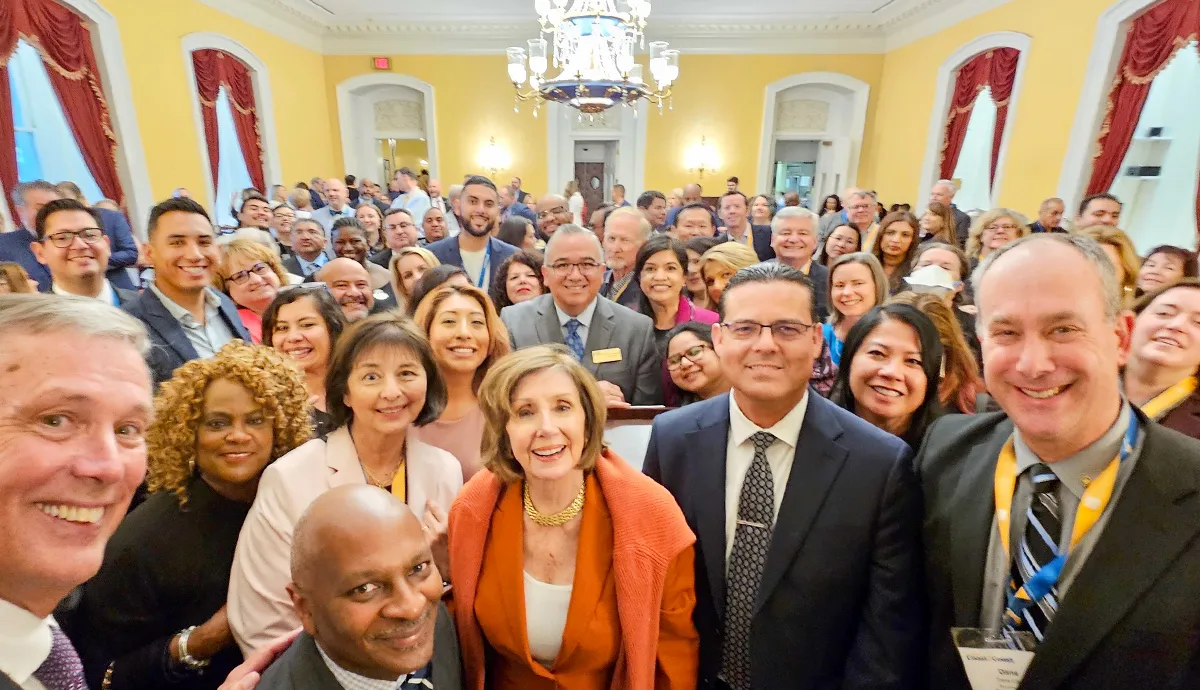
Beyond the general sessions and meetings, Coast2Coast offered opportunities for networking among participants and legislators. On April 9, attendees made their way to the U.S. Capitol, where they were welcomed for an evening reception. Special guests included Speaker Emerita Nancy Pelosi (CA-11) and Representatives Adam Schiff (CA-30), Pete Aguilar (CA-33) and Zoe Lofgren (CA-18).
When the Individuals with Disabilities Education Act (IDEA) was enacted almost 50 years ago, Congress promised to provide 40 percent of the average per-pupil expenditure to pay for the new federal mandate. That promise has never been fulfilled.
At the national level, the share of federal IDEA funding continues to shrink. In 2020–21, California’s share of federal funding equaled just 7.77 percent of total funds spent. In the same fiscal year, the local contribution to special education funding was over $10.7 billion, 64.4 percent of the total costs. Further, California allocated $15.5 billion, which was more than what was allocated at the federal level for the entire country in FY 2021. This underfunding has had a major impact on local schools’ abilities to balance annual operating budgets and maintain quality education programs and services for all children.
The ACSA-CSBA Federal Partnership advocated for support of HR 4519 (Huffman, D-CA 2) and S 2217 (Van Hollen, D-MD) — which would establish a glide-path to the 40 percent funding promise — along with HR 5141 (DeSaulnier, D-CA 10) to increase funding for Part B (Section 619) Preschool and Part C Infant/Toddler programs under IDEA.
Celinda Lake, founder, Lake Research Partners

From L-R: CSBA Vice President Debra Schade, CSBA President Albert Gonzalez, Rep. Adam Schiff and CSBA Immediate Past President Susan Markarian
To address recruitment and retention of teachers, the Partnership advocated for S 2417 (Smith, D-MN) to help alleviate recruitment and retention challenges across the nation through a federal grant program and S 962 (Lujan, D-NM) to establish the Loan Forgiveness for Educators Act. In addition, attendees advocated eliminating two Social Security-related penalties that are applied to California teachers.
The Affordable Connectivity Program (ACP), which provides a discount toward internet services for eligible households, is an important initiative to ensure people can afford the broadband they need for work, school, health care and more — at home. As of Jan. 22, 2024, California enrollment in ACP has reached 1.5 million households. Participants advocated for congressional action to extend ACP, without which these households will be kicked off of affordable internet services.
To protect the data of students and employees in schools, the Partnership supports S 1409 (Blumenthal, D-CT) and S. 1418 (Markey, D-MA), which focus on protecting student data. Additionally, to address cybersecurity issues, participants advocated for HR 2845 (Matsui, D-CA 7) to establish resources and a program to address cybersecurity in elementary and secondary schools through the federal Cybersecurity and Infrastructure Security Agency and the Federal Communications Commission Cybersecurity Pilot program.