

POLICY
Phone-Free Schools Act requires policy adoption
CSBA has updated two relevant sample policies
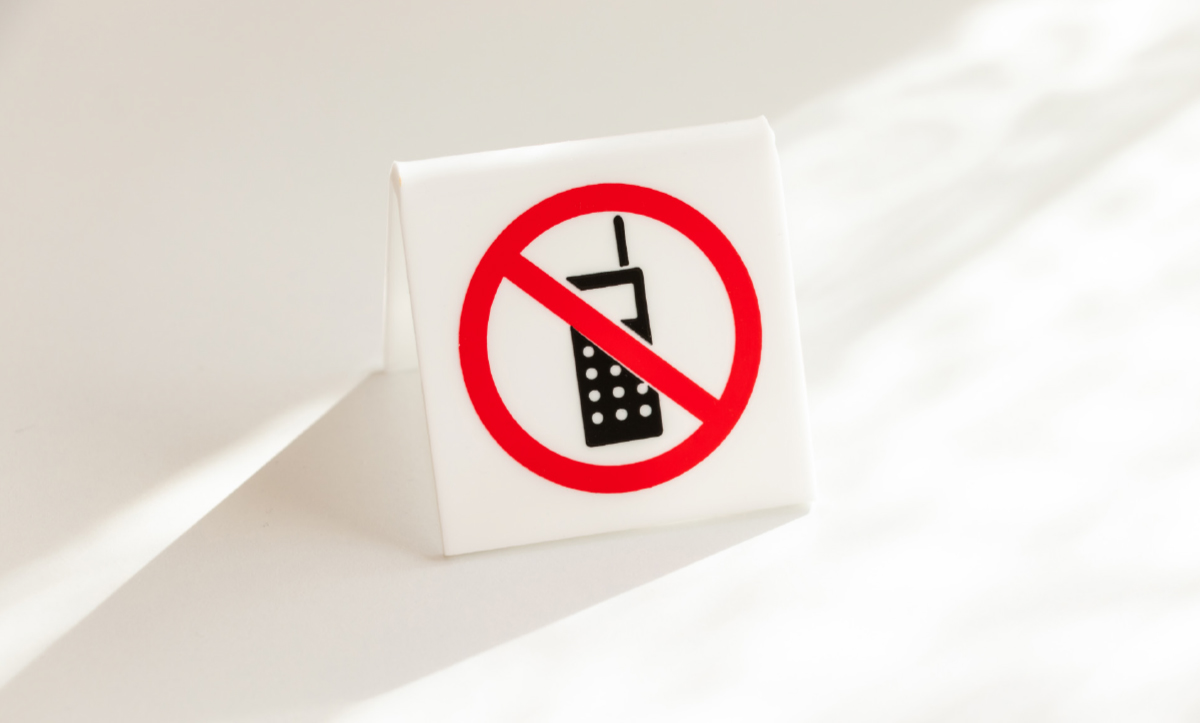
Landscape orientation digital stock image of a visible no cell phone symbol sign displayed on a bended white folded paper, indicating the forbidden of mobile phone usage set against a dark faded beige shadow background
In September 2024, Gov. Gavin Newsom signed Assembly Bill 3216, the Phone-Free Schools Act. This bill requires local educational agencies to develop and implement policies by July 1, 2026, that limit student use of smartphones while on school premises or under the supervision of an LEA employee. Such policies must be developed with significant stakeholder participation to ensure they are responsive to unique community needs and updated every five years.

This law builds on AB 272 (2019), which authorized, rather than mandated, LEAs to adopt such policies. AB 3216 includes limited exceptions for student cellphone use including in case of an emergency or in response to a perceived threat of danger; the student’s individual education program requires possession or use of a smartphone; a medical professional has determined that the possession or use of a smartphone is necessary for a student’s health or well-being; or a teacher or administrator grants permission to use or possess a smartphone, subject to any reasonable limitation imposed by that teacher or administrator. While AB 3216 requires LEAs to develop policies limiting smartphone use, they determine locally the extent of such limitation and how to implement these policies.

The prevalence of smartphones in schools presents a number of social and educational challenges. According to Gov. Newsom, “this new law will help students focus on academics, social development, and the world in front of them, not their screens, when they’re in school.” Pew Research polls report significant support for limiting phone use on campuses. A 2024 survey found that 68 percent of adults support prohibiting cellphone use during middle and high school classes, and 36 percent support an additional ban on use during lunch periods and between classes. Those in favor of limiting or prohibiting use cite numerous reasons for their support: limiting distractions (98 percent of respondents), encouraging development of better social skills (91 percent), limiting cheating (85 percent) and reducing bullying (70 percent). High school teachers in particular report that smartphones are obstacles in the classroom, with 72 percent of high school teachers surveyed stating that phones are a major problem.

“This new law will help students focus on academics, social development, and the world in front of them, not their screens, when they’re in school.”
Gavin Newsom, governor
Limiting student phone use also presents enforcement challenges for LEAs and their staff. Teachers and classroom aides will likely be responsible for enforcing any prohibition on phone use, including using class time to collect and redistribute phones. Additionally, LEAs choosing to enforce bans by storing phones in pouches or boxes will not only be responsible for covering the cost of storage systems, they will need to have a plan in place for quick access to the communication devices in an emergency. In addition, educators may face pushback from parents/guardians who are concerned about their ability to contact their children during the day, as well as students who oppose the limitations. Additionally, prior to implementing any new obligations imposed on staff, LEAs may be required to meet and confirm — or possibly negotiate — with labor unions.
Bans in action
Despite these challenges, some California schools have already successfully implemented cellphone bans. Dymally High School initiated its own cellphone ban in January 2020. Upon arrival, all students are required to place their cellphones in Yondr Pouches, small bags that automatically lock when closed and can only be opened using a specialized mechanism. In another example, for the past nine years, Holmes Middle School has required students to turn cellphones off or put them on silent mode and store them in their backpacks for the entire day. These schools report improvements in student socialization, extracurricular participation and academic engagement. The Los Angeles Unified School District, where both Holmes and Dymally are located, is also getting a jump start on phone regulation with a districtwide ban on cellphone use during school hours, which began in February. Whether phones may be stored in backpacks or collected will vary by school, with the district providing funding to purchase any necessary pouches or storage boxes.

CSBA will be updating two sample policies that address student cellphone use, Board Policy (BP) 5131.8 – Mobile Communication Devices and BP 5131 – Conduct, which, in addition to other changes, will incorporate requirements specified in the Phone-Free Schools Act. These updates will be released in mid-March as part of the quarterly update packet, making it an opportune time for LEAs to consider cellphone use within their school(s) and update related policy.