

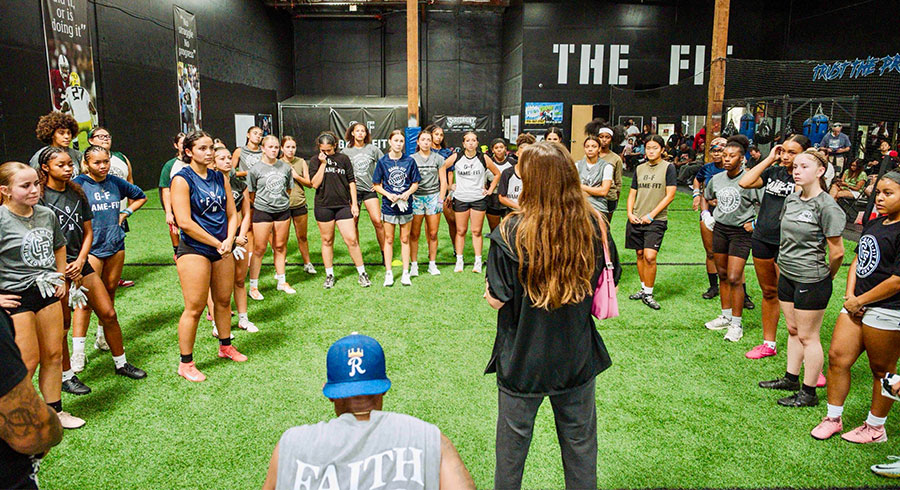
According to the latest CIF Sports Participation Survey released Aug. 3, flag football is now the sixth most popular sport among girls by participation.
Participation has grown from 10,000 in the first year to 25,000 at the end of the third year, according to CIF Associate Executive Director Brian Seymour. “We had about 442 teams roughly that played the inaugural season of flag football and now we’re just about shy of 900 teams.”
About half of U.S. states have sanctioned girls’ flag football at the high school level. While there was concern that adding another sport would pull girls’ attention away from current offerings, Seymour said that far more often, schools have seen students join teams for the first time.
She has witnessed the options open up for female athletes over the years, first while playing as wide receiver and cornerback for San Juan Unified School District’s El Camino Fundamental High School varsity and junior varsity football teams; followed by stints serving as offensive assistant coach at Diablo Valley College (DVC) for the men’s football team and an assistant coach for the women’s flag team at DVC.
“There are just so many girls from all sorts of backgrounds and sports all coming to flag football, some of them with flag experience, some without, but I go to these events and I just see so many girls. It’s sort of like a dream come true really to witness it,” DeNecochea said. “My younger self could not have imagined that this many women would be playing football 10 years later because it’s been a decade for me since I played, and it’s amazing.”
The draw among many of the girls she’s spoken to is the passion for a game that has largely been inaccessible. Some come from football families, others enjoy the camaraderie and many see the ability to get a scholarship to afford college.
However, her experiences isn’t unique. According to research from WeCOACH and the Tucker Center for Research on Girls and Women in Sport, the percentage of women coaching women’s teams at the collegiate level has declined from over 90 percent since Title IX was passed in 1972.
The 2025–26 Women in College Coaching Report Card shows a recent decline in the percentage of women head coaches after 13 years of steady progress. “While it is too early to determine if the decline is a long-term trend or a single-year anomaly … underlying biases are likely at play along with shifting cultural and sporting landscapes,” the report stated. “The historic popularity of women’s sports has made coaching women’s teams highly attractive and high stakes. Consequently, when filling prized positions, athletic directors may be defaulting to traditional, stereotypical and familiar hiring habits that favor men — limiting opportunity for qualified women.”
This creates a break in the pipeline that would allow girls playing flag football to see a future in the game they love, DeNocochea said.
“A lot of these girls, they’re going to grow up and not all of them are going to go pro with this. And even if they do, they might retire at some point, retire their cleats and want to get into coaching flag,” she explained. “And will it be a space that’s open to women? I don’t know. I think it would be nice to see more support around women coaches in this field as flag football expands to see women leading this movement of women’s sport. I think it’s important.”
While the CIF doesn’t track that same data at the K-12 level, Seymour said that one of the federation’s goals has been to help schools understand that there is a need to have quality coaches and sports officials that give back to their schools.
“We have plenty of room to grow in the development and promotion of women as head coaches in all of our sports, whether they are girls’ sports or boys’ sports, and we need to find better ways to make that pathway more open to everyone,” Seymour said. “We are starting to see more and more females who are head coaches, not assistant coaches, but head coaches in a lot of sports, including traditional boys’ sports that they are now head coaches at because they have tremendous ability to do that.”
