





Winter 2026
The California School Boards Association is the essential voice for public education. We inspire our members to be knowledgeable leaders, extraordinary governance practitioners and ardent advocates for all students.

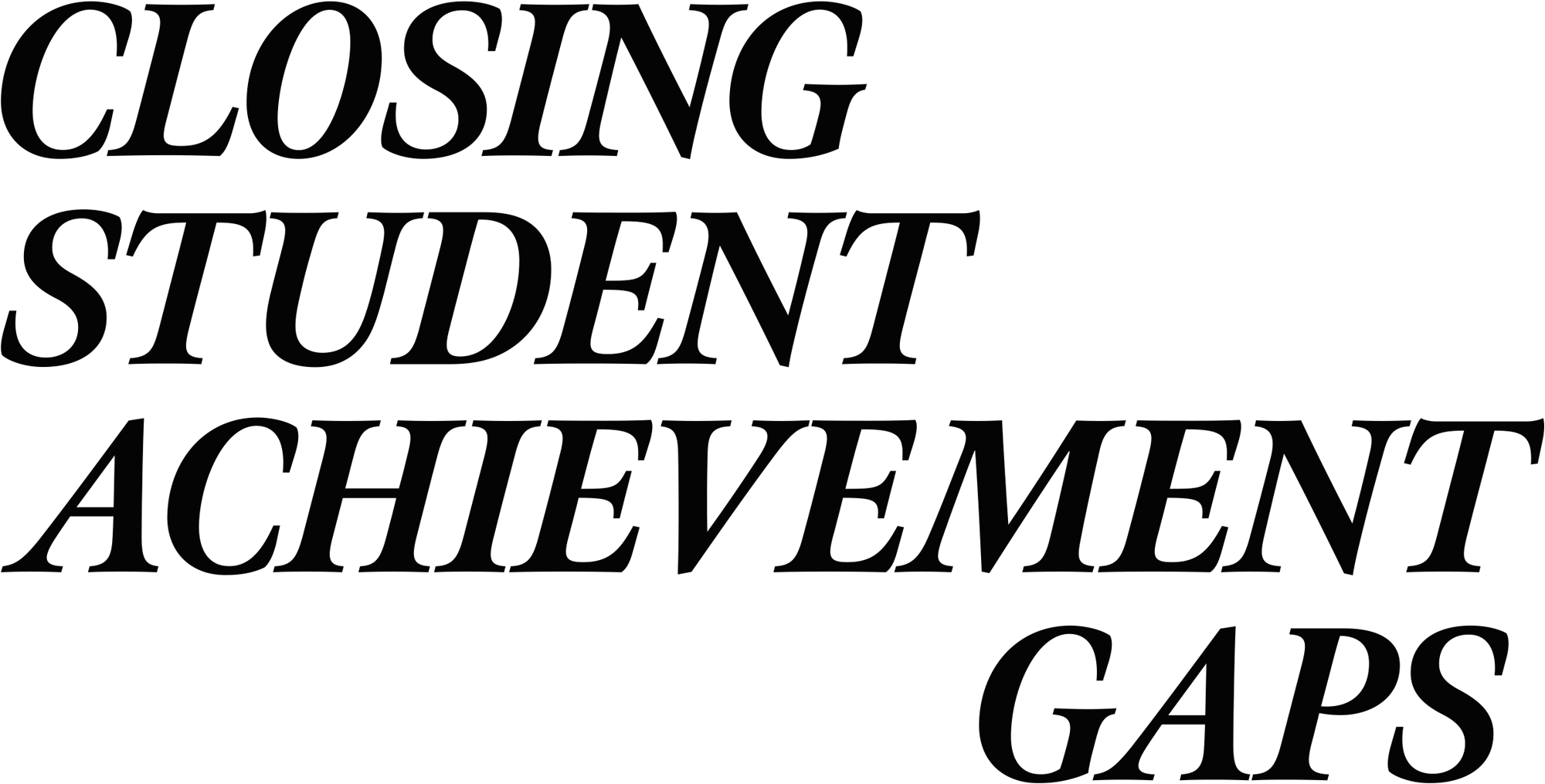
CSBA’s call to action for a state-level plan to address a decades-long issue
by Heather Kemp

College and career education paves a bright path forward for underserved youth
by Alisha Kirby

Will new legislation combined with existing initiatives move the needle on student literacy?
by Kimberly Sellery
CEO’s note
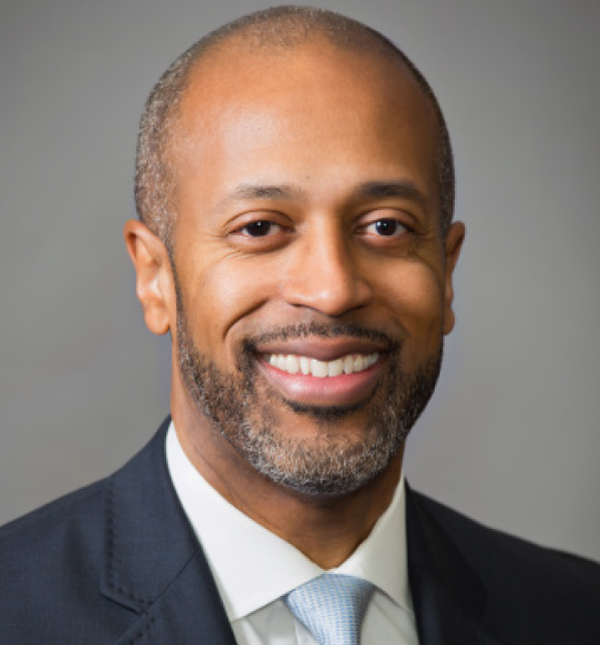
by Vernon M. Billy

alifornia’s current wave of collective bargaining is unfolding in one of the most complex and fragile fiscal environments in decades. Coordinated campaigns and strike headlines may suggest the central question is whether school districts are willing to prioritize educators, but that framing misses a deeper reality: the most powerful levers shaping districts are controlled not locally, but in Sacramento.

Despite what some may claim, school board members and superintendents don’t accept these positions because they harbor a secret desire to sabotage the labor movement or to impoverish teachers. They stepped into those roles because they cherish education, respect its value to society and want to develop the best possible version of public schools for their communities. Trustees and superintendents recognize how integral teachers are to that vision, and they want to reward teachers for their incredibly important work. Yet, these desires don’t occur in a vacuum.

CSBA 2026 Board of Directors
-
Tyler NelsonRegion 1, Ukiah USD
-
Bruce RossRegion 2, Redding ESD
-
Robin JankiewiczRegion 3
-
Renee NashRegion 4, Eureka Union SD
-
Patricia MurrayRegion 5
-
Jackie Thu-Huong WongRegion 6, Washington USD
-
Rachel HurdRegion 7, San Ramon Valley USD
-
Christopher “Kit” OaseRegion 8, Ripon USD
-
Roger SnyderRegion 9, Scotts Valley USD
-
Kathy SpateRegion 10, Caruthers USD
-
Daniel SandovalRegion 11
-
William FarrisRegion 12, Sierra Sands USD
-
Annette LewisRegion 14, Contra Costa COE
-
Susan HenryRegion 15, Huntington Beach Union HSD
-
Karen GrayRegion 16, Silver Valley USD
-
Eleanor EvansRegion 17, Oceanside USD
-
Bruce DennisRegion 18, Riverside COE
-
Devon ConleyRegion 20, Mountain View Whisman SD
-
Rocio RivasRegion 21
-
Nancy SmithRegion 22, Palmdale SD
-
Helen HallRegion 23, Walnut Valley USD
-
Jan BairdRegion 24, South Whittier ESD
-
Chris ClarkDirector-at-Large African American, Folsom-Cordova USD
-
Christina Cameron-OteroDirector-at-Large American Indian, Needles USD
-
Sylvia LeongDirector-at-Large Asian/Pacific Islander, Cupertino Union SD
-
Michael TeasdaleDirector-at-Large County, Ventura COE
-
Alma Carina CastroDirector-at-Large Hispanic, Lynwood USD
legal insights
ince the U.S. Supreme Court’s holdings that the Constitutional guarantee of free speech extends to both students and employees in schools, questions about the scope of that right have persisted and, with recent events, have gained significant media attention. Social media, political debates and current events have tested the public’s understanding of the concept of free speech and, given the pivotal role of local educational agencies in communities, it is no surprise that schools have been at the center of many emerging legal questions.

Chief Information Officer
Troy Flint, tflint@csba.org
Editorial Director
Kimberly Sellery, ksellery@csba.org
Senior Staff Writers
Heather Kemp, hkemp@csba.org
Alisha Kirby, akirby@csba.org
Director of Marketing and Communications
Monica Griffis, mgriffis@csba.org
Director of Graphic Design and Branding
Kerry Macklin, kmacklin@csba.org
Senior Graphic Designer
Amanda Moen, amoen@csba.org
Graphic Designer
Thairah Singharath, tsingharath@csba.org
CSBA officers
Dr. Debra Schade, Solana Beach SD
President-elect
Sabrena Rodriguez, Ventura USD
Vice President
Jackie Thu-Huong Wong, Washington USD
Immediate Past President
Dr. Bettye Lusk, Monterey Peninsula USD
CEO & Executive Director
Vernon M. Billy
Articles submitted to California Schools are edited for style, content and space prior to publication. Views expressed are those of the authors and do not necessarily represent CSBA policies or positions. Articles may not be reproduced without written permission of the publisher. Endorsement by CSBA of products and services advertised in California Schools is not implied or expressed.


CSBA Presidents from 1931 to 2031
Prompted by discussions among several boards throughout California about the need to advocate for educational programs, 29 school board members from 12 counties gathered at the Donner School auditorium in Sacramento on Sept. 8, 1931, to form the California School Trustees Association, later to be known as the California School Boards Association. The association began with a simple mission statement: “The purpose of the organization shall be to promote the best interests of the schools of the State of California”.
Congratulations
to CSBA’s Masters in Governance® Class of 2025!*
More than 2,000 board members and superintendents have participated in CSBA’s highly acclaimed Masters in Governance program.
CSBA’s Masters in Governance (MIG) program equips board members and superintendents with the knowledge and skills to build and support an effective governance structure.
The following graduates have successfully completed the 2025 in-person and virtual MIG program, gaining essential knowledge for being an effective governance team member.
Amanda Vasquez
Apple Valley USD
Anita Tucker
Renee Longshore
Auburn Union ESD
Greg Holt
Emily Travis
Denise Cudd
Buckeye Union ESD
Melissa Keyzer
Carmel USD
Matt Glazer
Beatriz Mora
Deby Ellet
Yolanda Tabarez
Ceres USD
Amy Peterman
Cynthia Ruiz

s artificial intelligence (AI)-powered education technology (edtech) apps proliferate and post-pandemic achievement gaps widen, school board leaders are feeling the pressure to modernize learning, perhaps now more than ever before. But what does modernization actually mean in K-12 education? Why is it so important? And how can boards of education lead modernization efforts in a way that helps, rather than harms, the students they serve?

research spotlight
25 years of California’s accountability system
Over a decade after implementing the LCFF and LCAP, discussions continue on how to improve the state’s accountability system to better support student outcomes, especially addressing persistent achievement gaps. Although California’s accountability systems can be viewed from different angles, this article examines two distinct eras of the past 25 years before exploring where the state might head next.
If I had to pick one accomplishment I’m most proud of, it would be helping launch and sustain our district’s Newcomer Camp, now in its fourth year. The camp supports students who are new to the United States or still learning English, giving them a chance to strengthen their language skills, build confidence and feel welcomed in our schools. Seeing students arrive shy and unsure, and leave with new friendships, stronger communication skills and ready to participate in our classrooms is incredibly rewarding.
My parents inspired me from a very early age. They were always involved in our schools, working to ensure all kids, regardless of background, felt included and free to learn. They were also prolific letter writers supporting our public schools and taught me and my sisters how active participation in our community could make life better for everyone. Through their actions, we learned that if we want schools and a community where everyone can feel welcome and thrive, then we must actively participate and volunteer.
Invest the time to take Masters in Governance and learn the responsibilities and work of being a trustee. Being a member of a governance team is truly different than anything else they have ever done — no matter how prepared they think they are.
Advocacy and establishing partnerships are absolutely key to being an effective trustee. Being a publicly elected official, doors open more easily and create numerous opportunities to reach out and bring vital resources to the children we serve, like crossing guards, school resource officers, student internships, inspirational speakers, musical instruments, arts and science programs, career technical education tools, school supplies, mental health support, food and clothing pantries, and so much more.
CSBA has played a huge role in my development as a trustee! Masters in Governance, seminars, the Annual Education Conference and Trade Show, Delegate Assembly, networking and advocacy all provided me opportunities to learn, grow and navigate more effectively in my role as a school board member, especially during difficult times. CSBA also provided a deeper understanding of the rich diversity of school districts in our state — from small and rural, to large and urban.
Would you like to participate in an upcoming Member Profile? Contact editor@csba.org.
If I had to pick one accomplishment I’m most proud of, it would be helping launch and sustain our district’s Newcomer Camp, now in its fourth year. The camp supports students who are new to the United States or still learning English, giving them a chance to strengthen their language skills, build confidence and feel welcomed in our schools. Seeing students arrive shy and unsure, and leave with new friendships, stronger communication skills and ready to participate in our classrooms is incredibly rewarding.
My parents inspired me from a very early age. They were always involved in our schools, working to ensure all kids, regardless of background, felt included and free to learn. They were also prolific letter writers supporting our public schools and taught me and my sisters how active participation in our community could make life better for everyone. Through their actions, we learned that if we want schools and a community where everyone can feel welcome and thrive, then we must actively participate and volunteer.
Invest the time to take Masters in Governance and learn the responsibilities and work of being a trustee. Being a member of a governance team is truly different than anything else they have ever done — no matter how prepared they think they are.
Advocacy and establishing partnerships are absolutely key to being an effective trustee. Being a publicly elected official, doors open more easily and create numerous opportunities to reach out and bring vital resources to the children we serve, like crossing guards, school resource officers, student internships, inspirational speakers, musical instruments, arts and science programs, career technical education tools, school supplies, mental health support, food and clothing pantries, and so much more.
CSBA has played a huge role in my development as a trustee! Masters in Governance, seminars, the Annual Education Conference and Trade Show, Delegate Assembly, networking and advocacy all provided me opportunities to learn, grow and navigate more effectively in my role as a school board member, especially during difficult times. CSBA also provided a deeper understanding of the rich diversity of school districts in our state — from small and rural, to large and urban.
Would you like to participate in an upcoming Member Profile? Contact editor@csba.org.
class act
Best practices in action
West Covina USD’s Speech and Debate Program prepares students for success
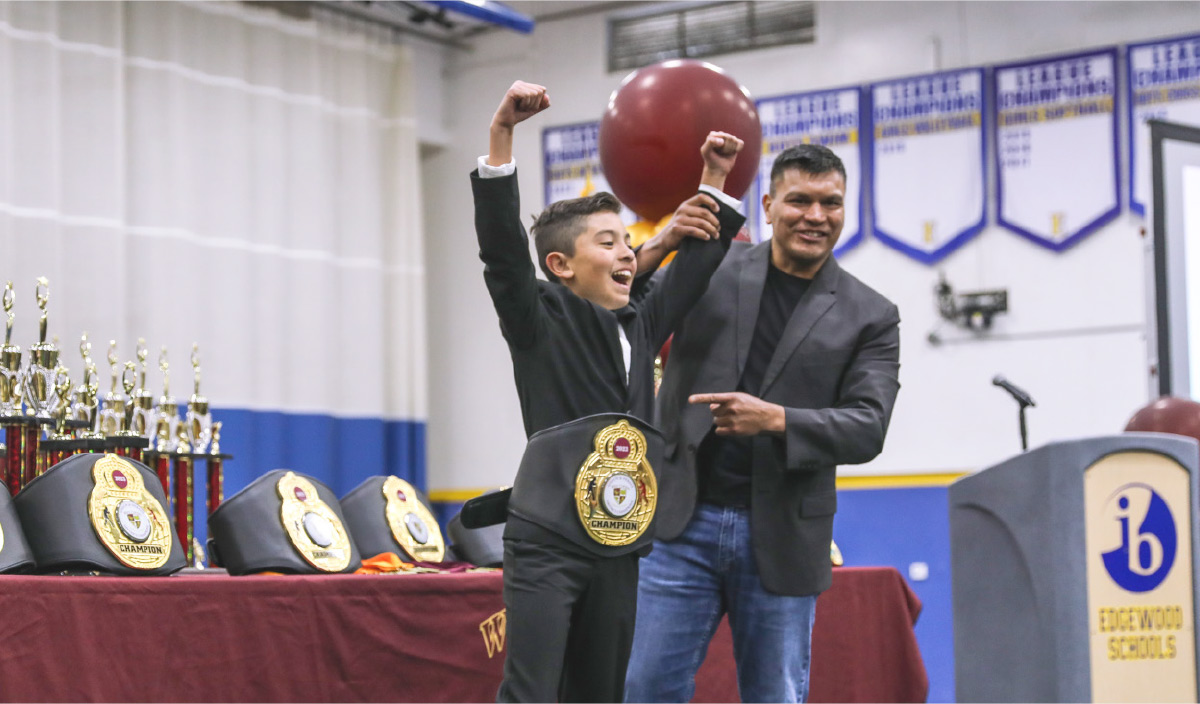
Superintendent Emy Flores is a strong advocate of the program, implementing similar efforts at previous local educational agencies she helped lead before joining the Los Angeles County district in early 2022. By the end of that year, West Covina USD launched its initiative as a summer camp, which drew immediate interest from the community, Flores recalled.
BoardWise
Boardwise is a forum for board members and superintendents across the state to share questions about governance and board–superintendent relations. Send your questions to boardwise@csba.org. Have governance team questions that require personal attention? Reach out to gcs@csba.org for a customized Governance Consulting Workshop.
Advertorial
Health-e-Kids helps schools unlock CYBHI funding with near-perfect claims success
Health-e-Kids, developed by Practi-Cal, is transforming this scenario. Designed specifically for school health teams, Health-e-Kids helps Local Educational Agencies (LEAs) navigate the complexities of CYBHI billing, ensuring that schools receive the reimbursements they deserve.


Throughout my years as a teacher, principal and district administrator, grading in schools was like the old joke about the weather: everyone complained, no one did anything. Students, families and faculty knew that no teachers graded the same. Two students in adjacent Algebra I rooms could have identical understanding yet receive different grades because of variation in late-work penalties, tardies, extra credit or participation points. The variability was understandable — most teachers receive little preparation for how to grade — but it was also confounding; district leaders’ attempts to increase consistency in grading often would devolve into accusations of administrative overreach and threats to teacher autonomy.
Student
Achievement
Gaps
Student
Achievement
Gaps
Though local educational agencies are consistently held accountable for the role they play in the outcomes of learners through metrics included on the California School Dashboard, their students’ California Assessment of Student Performance and Progress (CAASPP) scores and other means, no such formal measures exist at the state level.
Over the years, CSBA has been concerned by the lack of meaningful action on the topic and advocated for the disparities to be addressed. However, due to the state’s ongoing lack of urgency and accountability on the matter, worries have amplified and resulted in a call to action that CSBA CEO & Executive Director Vernon M. Billy explained to members during the 2025 Annual Education Conference and Trade Show (AEC), which took place Dec. 3-5 in Sacramento.
Though local educational agencies are consistently held accountable for the role they play in the outcomes of learners through metrics included on the California School Dashboard, their students’ California Assessment of Student Performance and Progress (CAASPP) scores and other means, no such formal measures exist at the state level.
Over the years, CSBA has been concerned by the lack of meaningful action on the topic and advocated for the disparities to be addressed. However, due to the state’s ongoing lack of urgency and accountability on the matter, worries have amplified and resulted in a call to action that CSBA CEO & Executive Director Vernon M. Billy explained to members during the 2025 Annual Education Conference and Trade Show (AEC), which took place Dec. 3-5 in Sacramento.



he Bathroom Bandits joined WorkAbility I (WAI), a career awareness, exploration and training program for special education students ages 12 to 22, and were hired to operate the snack bar during soccer games.
School staff “were hoping that was going to be that carrot that kept them engaged and wanting to be at school and continue to persevere,” said Zach Franceschetti, San Joaquin County Office of Education WAI program coordinator. Historically, the program has had significant impacts on students, he explained.

hile state leaders lauded incremental improvements in English language arts (ELA) demonstrated by 2025 California Assessment of Student Performance and Progress results, they also acknowledged there is more work to be done, with less than half of the state’s 5.8 million students meeting grade-level standards. Additionally, large gaps in achievement between student groups continue to languish without the movement needed to accelerate outcomes in lower-achieving groups.
During an Oct. 9 webinar attended by education leaders, policymakers and media, CSBA called for the State of California to adopt a coherent, state-level plan for how it will better support — not dictate — the work of local educational agencies in closing achievement gaps.
ith the 2025 legislative year in the rearview mirror, it is time to release CSBA’s annual Legislative Scorecard. The scorecard is a helpful tool to assess how your state legislators are voting on important measures that impact school districts, county boards of education and public education overall. Last year saw more than 800 bills reach Gov. Gavin Newsom’s desk, which included a number of high profile education bills. They included legislation to address the growing incidences of antisemitism, efforts to increase nonclassroom-based charter school oversight and helping alleviate the teacher shortage by allowing substitutes to serve longer in a classroom.
Notably, four CSBA-sponsored measures reached the Governor’s desk with just one vetoed and the rest signed into law. The three bills signed by Gov. Newsom will help to expand access to education workforce housing, modernize decades-old school district and county board of education stipends, and reduce administrative workloads. The fourth bill would have provided much-needed relief to school districts and county offices of education by temporarily expanding the time a substitute teacher may teach in a classroom from 30 to 60 days.
a conversation with…
a conversation with…



ad index
- Assist Programs14
- Atikinson, Andelson, Loya, Ruud & Romo63
- Burke, Williams & Sorensen, LLP40
- BuyBoard33
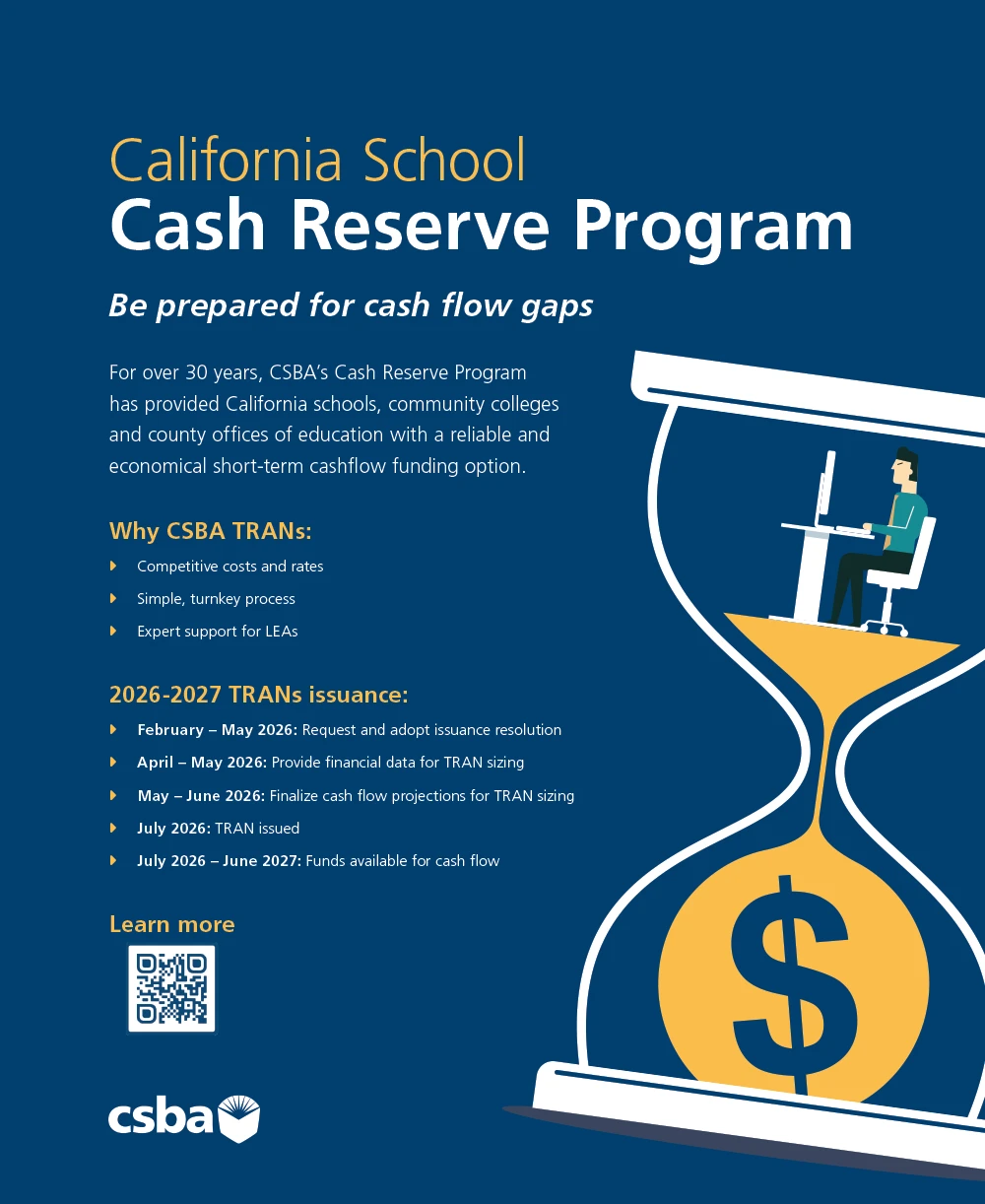
- California Schools Cash Reserve Program1
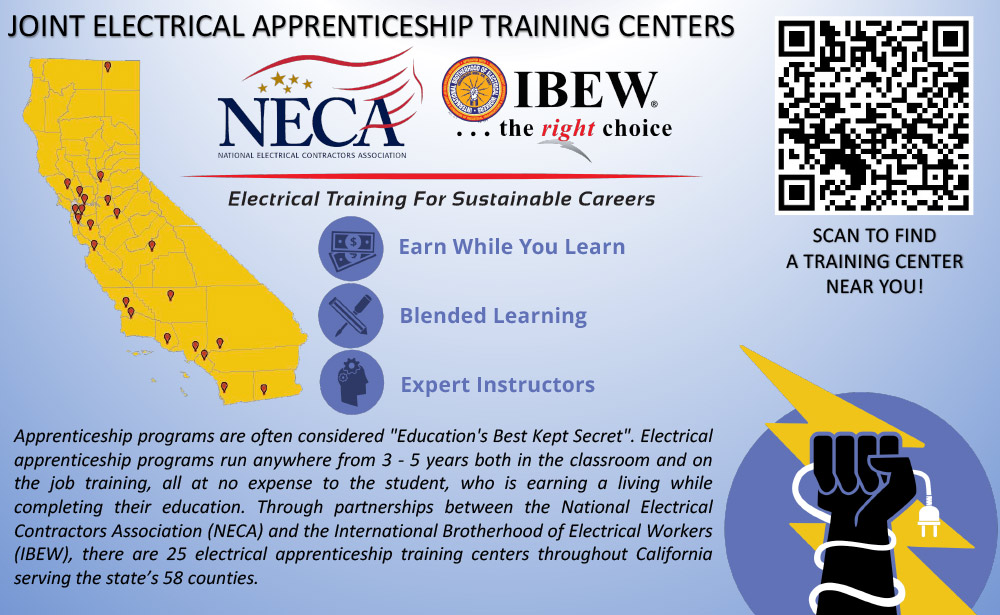
- California Statewide Electrical JATC38
- Certificates of Participation61
- Climatec30
- CSBA Business Affiliates and Partners ProgramsIBC
- CSBA Coast2Coast4
- CSBA Education Legal Alliance20
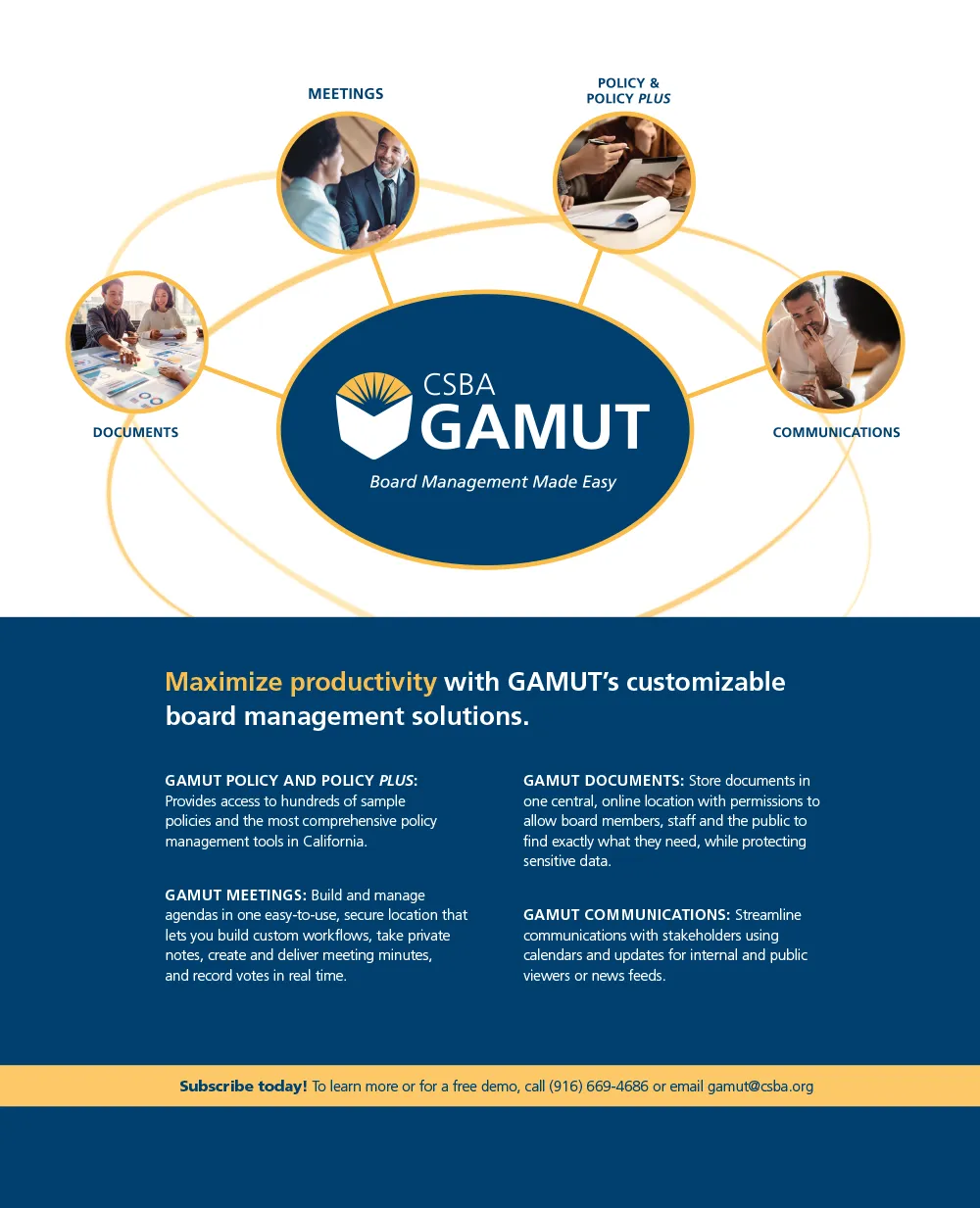
- CSBA GAMUT31
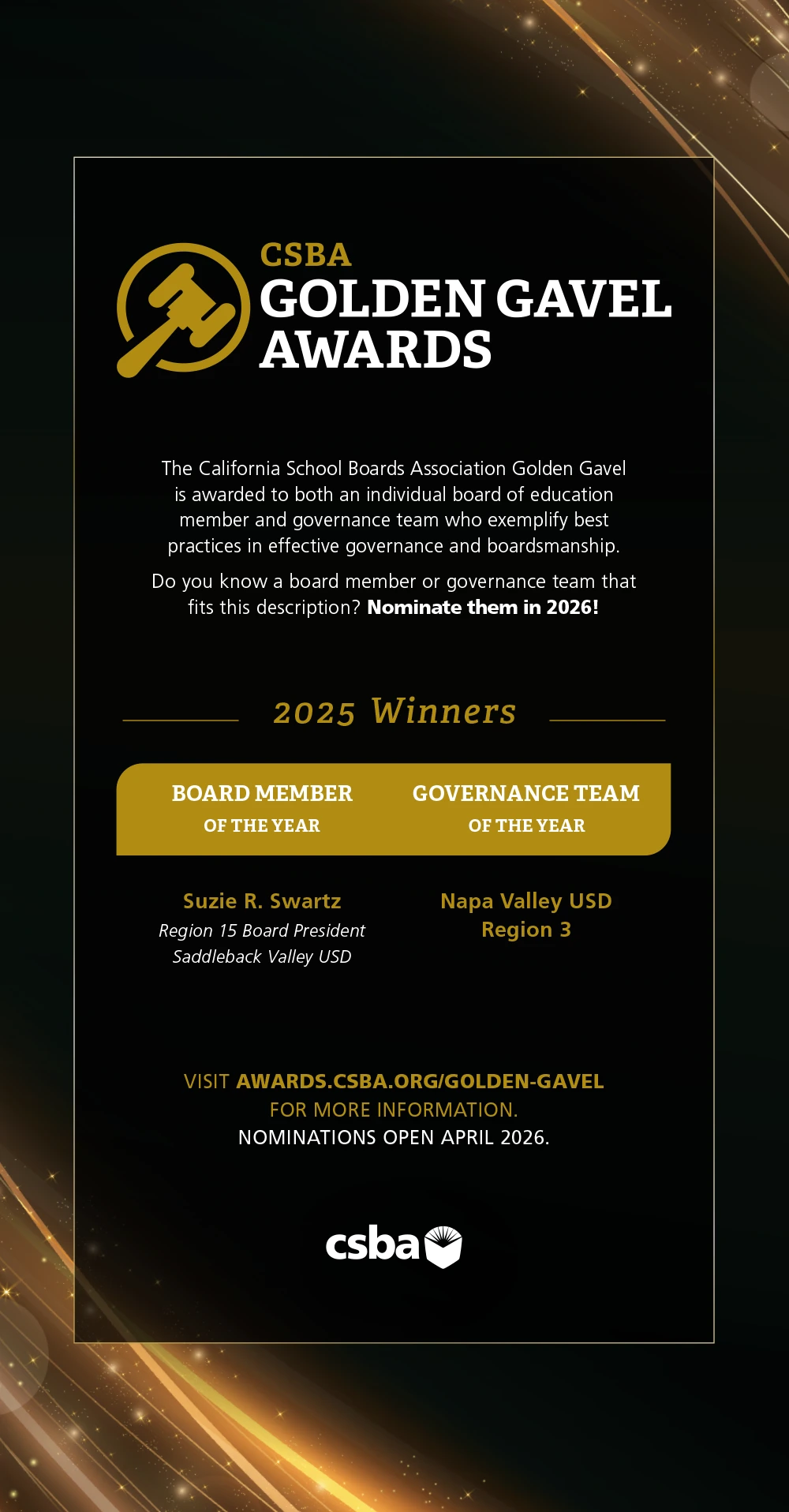
- CSBA Golden Gavel Awards52
- CSBA Golden Quill Awards51
- CSBA Legal ServicesIC
- CSBA Masters in Governance10
- CSUN Center on Disabilities12
- CSUN Center on Disabilities24
- Dale Scott & Co42
- Dannis Woliver Kelley2
- Fagen Friedman & Fulfrost, LLP39
- Jones Hall32
- Keenan & Associates41
- Lozano SmithBC
- National Demographics22
- Nor Cal Carpenters Union49
- OPEB43
- Opterra48
- Orbach Huff + Henderson LLP53
- PARS62
- Piper Sandler18
- PowerSchool16
- Practi-Cal21
- SELF50
- Western States Regional Council of Carpenters25
Thanks for reading our Winter 2026 issue!