

Close the State Accountability Gap
Vernon M. Billy
Close the State Accountability Gap
Q&A
WITH CSBA CEO & EXECUTIVE DIRECTOR VERNON M. BILLY
An SOS for reciprocal accountability and student achievement
CSBA’s plan to close the state accountability gap
Q1
What prompted CSBA to launch the SOS for Student Achievement: Close the State Accountability Gap (SOSSA) campaign?
The campaign was prompted by a reality that local school district and county office of education (COE) board members confront every day: California holds local educational agencies accountable for student outcomes, but the state has never created an equally coherent, measurable plan for how its own agencies, budgets, policies and programs will support LEAs in closing achievement gaps — known as reciprocal accountability. We launched this effort after another round of state and national data showed that, despite the hard work happening locally, achievement gaps remain stubborn and, in some cases, are widening.

As long as this state accountability gap exists, LEAs can do everything asked of them and still struggle when state programs are fragmented, guidance is conflicting, funding is misaligned, technical assistance is inconsistent or reporting requirements pull staff away from implementation. Student outcomes remain the ultimate reason for this work, but the campaign is focused on the state-level conditions that make local success more likely.
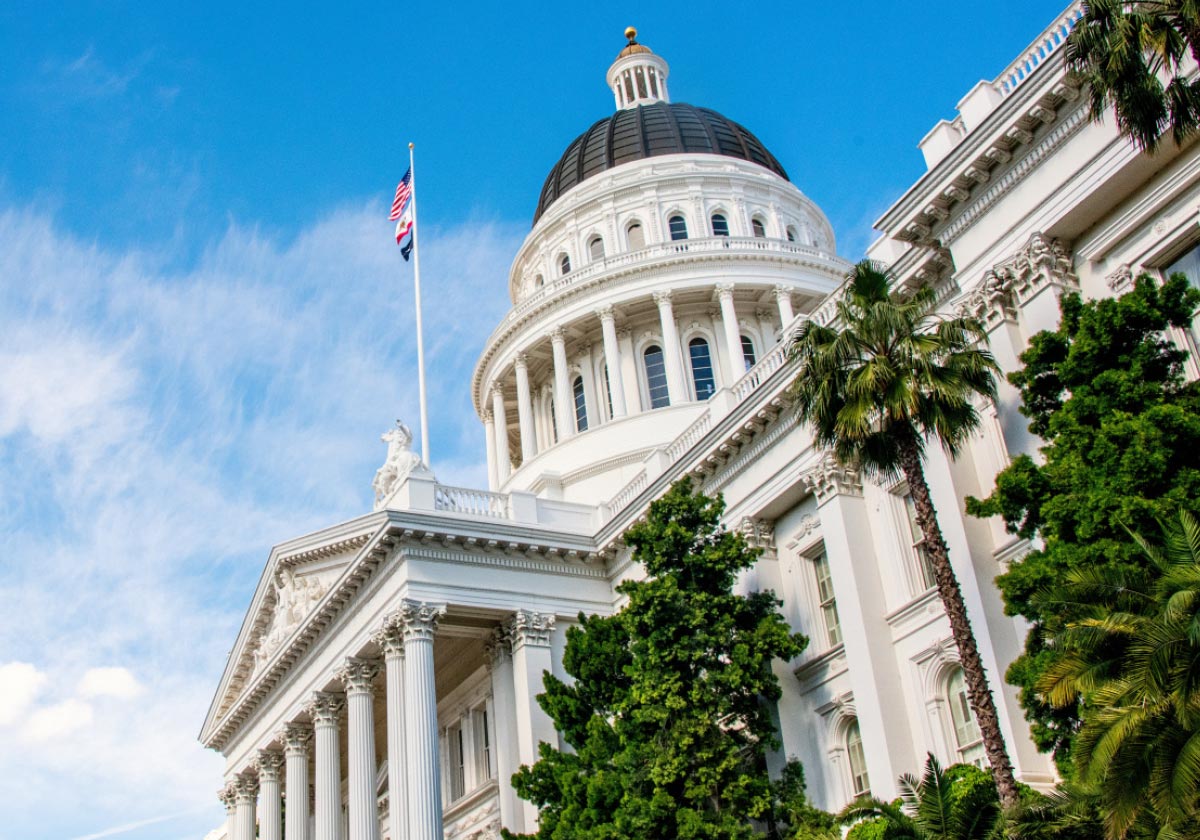
Low-angle view of the California State Capitol dome and white columns framed by palm trees against a blue sky.
California holds local educational agencies accountable for student outcomes, but the state has never created an equally coherent, measurable plan for how its own agencies, budgets, policies and programs will support LEAs in closing achievement gaps.

Q2
How does this campaign relate to student achievement?
The Close the State Accountability Gap campaign evolved from a CSBA-driven policy conversation about the state’s role in student achievement. CSBA announced the campaign in October 2025 following 2024 state and national testing data that showed stagnant or widening academic disparities, and after meeting with several other statewide education organizations to discuss our desire to push for substantive change at the state level.

Persistent achievement gaps remain the reason CSBA is pushing for reform. But the current stage of the campaign is less about restating the problem and more about identifying the state-level responsibilities that have too often escaped attention and complicated local efforts to accelerate student achievement.

California has spent years documenting achievement gaps. The question now is whether state government can be organized to help LEAs close them.

Q3
What is the core problem the campaign is trying to solve?
The “Close the State Accountability Gap” phrasing names the problem we’re addressing directly: a persistent imbalance in accountability. California holds school districts and county offices of education accountable for student performance, spending, planning, reporting and improvement, but the state has not held itself to a comparable standard for whether its own agencies, policies, programs, mandates and funding decisions help local schools succeed.

California already has extensive tools for measuring local school performance. Districts and COEs are scrutinized by voters, parents, public meetings, audits, Local Control and Accountability Plans (LCAPs), fiscal reviews, program monitoring, state dashboards and student achievement data.

What California lacks is a parallel system for measuring whether state action is coherent, coordinated and helpful. The state controls many of the conditions under which LEAs operate — funding formulas, categorical programs, statutes, regulations, data systems, reporting rules, technical assistance structures and accountability expectations. If those state actions are not aligned, local schools pay the price. Closing the state accountability gap means the state should evaluate its own performance as carefully as it evaluates local schools.
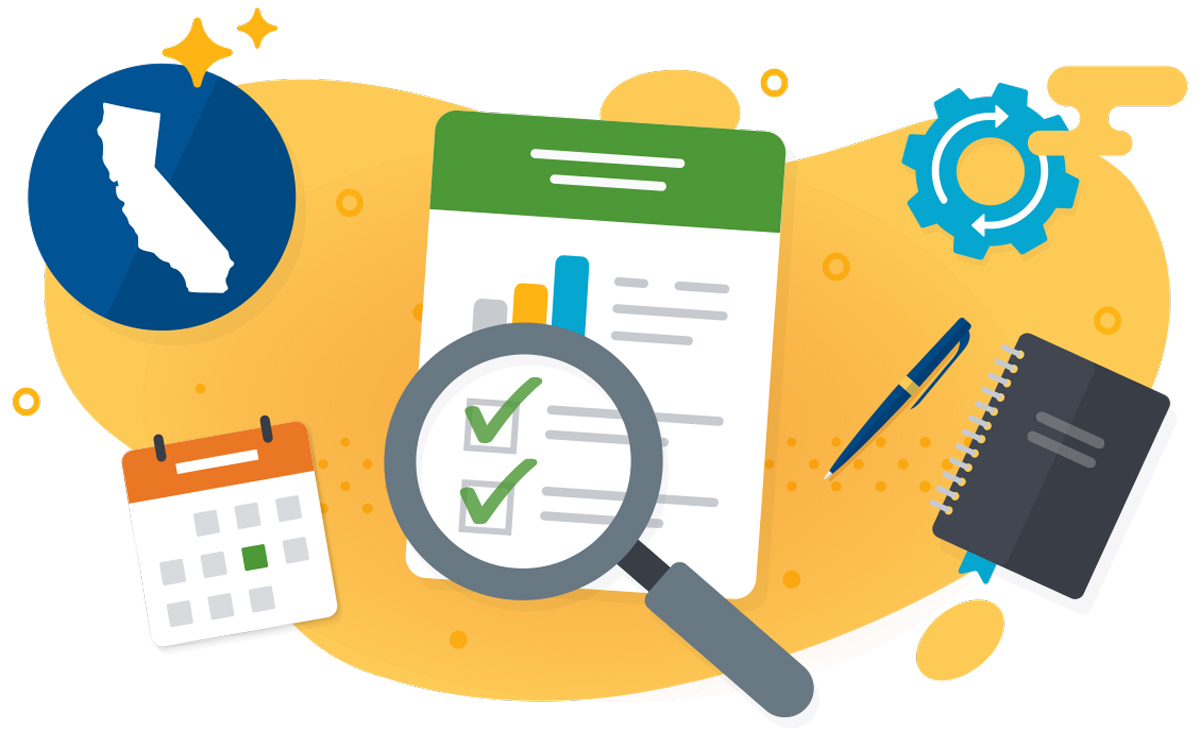
Flat graphic illustration of planning tools including a California map icon, report with magnifying glass, calendar, and notebook.
Q4
What are the bills in the Close the State Accountability Gap legislative package?
The package includes four complementary bills sponsored by CSBA and collectively known as the SOS for Student Achievement: Close the State Accountability Gap legislation. The bill package creates the framework for a stronger system of state-level support, focus and accountability. This legislation complements Assembly Bill 181, Gov. Gavin Newsom’s recently signed legislation that streamlines the state’s education governance model by changing the authority of the state superintendent of public instruction and moving school oversight under a new education commissioner role appointed by the governor. We believe our package of bills would have extended AB 181’s guiding principles of greater coherence and improved efficacy in service of LEAs. Collectively, the legislation would have created a state-level operations plan to enhance service to local schools, ensure alignment across state agencies, require clear and regular reporting on the success of state programs, strengthen state support and technical assistance for LEAs and connect state governance reform to measurable outcomes for students.

The bills were authored in the same spirit as AB 181. Though three were held in the Senate Appropriations Committee, AB 2225 remains in play and, if signed, will amplify the focus on planning and coherence needed to improve California’s system of education governance.

AB 2225 by Assemblymember Darshana Patel (D-San Diego) convenes a broad stakeholder workgroup to create a plan for greater state-level support to help LEAs close achievement gaps. The bill requires clear goals and benchmarks, annual performance targets for state-level action, and evaluations of key state education bodies and programs.

Amendments now require the newly established education commissioner to report on the state’s progress in bringing its public education governance system into alignment with the overall goal of helping to improve student outcomes and close achievement gaps.

Closing the state accountability gap means the state should evaluate its own performance as carefully as it evaluates local schools.

AB 2149, authored by Assemblymember Robert Garcia (D-San Bernardino), would have required the Legislative Analyst’s Office (LAO) to periodically evaluate and report on the alignment between the state plan and the state’s proposed and adopted budgets, including a review of the funded status of mandates. The intent is for the report and associated recommendations to guide the work of the state and to help implement and align work to the state plan established through AB 2225.

AB 2514 by Assemblymember Rhodesia Ransom (D-Tracy) would have established a state-level tool — the State Educational Alignment and Impact Tool (SEA-IT) — to provide a clear and concise method of informing the public of the state’s progress in implementing the state plan for closing achievement gaps.

AB 2202 from Assemblymember Al Muratsuchi (D-Torrance) would have established a commission under the State Board of Education (SBE) to develop a publicly available system of monitoring the performance of new and existing state programs to support LEAs in closing achievement gaps, consistent with the state plan. The commission will also help identify more efficient methods of supporting LEAs through the Statewide System of Support.

Q5
How would SEA-IT be different from the California School Dashboard?
The dashboards would measure two completely different concepts. The California School Dashboard measures the progress of LEAs and student groups. SEA-IT would measure the state’s progress in improving support of and service to LEAs. The SEA-IT dashboard is part of CSBA’s effort to create an operations and support infrastructure, complete with a feedback loop that measures and enhances state service quality, program effectiveness, and operational efficiency, among other things. In this way, it is little different than the dashboards Gov. Newsom has required his state agencies to produce tracking key issues like homelessness, artificial intelligence workforce impacts, wildfire prevention and teacher supply.
Q6
What do you mean by “support — not dictate to” local educational agencies?
Local control matters because communities understand their students’ needs. But local control cannot mean local responsibility without state partnership. “Support — not dictate to” means the state should remove barriers, align funding with priorities, reduce conflicting mandates, provide high-quality technical assistance and evaluate whether its own programs help or hinder local progress. It also means the state should not add more reporting burdens to LEAs under the banner of accountability.
Q7
Isn’t the campaign really about reducing compliance obligations for LEAs?
No, and such a critique would be both misleading and reductive. The central focus of these bills is establishing a reciprocal accountability system that ensures the state is responsible for its actions in the same way LEAs are held to account. Accountability and compliance are not the same. Some compliance requirements protect students and families and must remain strong. Other requirements consume staff time, divide local attention or conflict with other state priorities without improving student achievement. This campaign asks the state to distinguish between the two and determine which state requirements support local efforts to boost student performance and close achievement gaps, and which requirements detract from that work.
Q8
Does the package shift responsibility away from local school boards?
No. Local school boards remain accountable for student outcomes in a multitude of ways. They adopt LCAPs, review budgets, hold public meetings, answer to voters, track test scores and make hard decisions in public. Close the State Accountability Gap legislation does not erase that responsibility.
Together, AB 181 and the Close the State Accountability Gap bills could have turned governance reform into a durable system of reciprocal accountability.

For example, at the hearing on AB 2225, Winters Joint USD Superintendent Roddy Boonchouy testified that districts are already held accountable through the California School Dashboard, LCAPs, audits, public reporting and elected boards, but added that local accountability alone cannot close gaps if the state system lacks coherence and alignment. I think that gets at the heart of this legislation.
Q9
How has AB 181 changed the landscape for this campaign?
AB 181 cast a brighter light on the benefits of greater alignment and coherence in state budgeting, policy and programs, as well as the need for more effective support of LEAs, all issues that CSBA advocated for, elevated and introduced into the common education discourse through the Close the State Accountability Gap campaign. By virtue of the attention CSBA’s campaign drew to accountability, Gov. Newsom and the Legislature recognized that California’s state education governance system is too fragmented and that clearer lines of authority are needed. By creating an education commissioner under the SBE and shifting California Department of Education (CDE) executive functions into that new structure, AB 181 begins to address a longstanding governance problem.

CSBA supported AB 181 because it is an important first step away from disconnected state oversight and toward a more coherent state system. But AB 181 is a starting point, not the endpoint. This is where the Close the State Accountability Gap legislation would have supplemented and amplified AB 181 with a process and a pathway to enhanced support for school districts and COEs.

Group of six joyful young students in colorful outfits jumping in the air in front of a school building wall.
The unfortunate committee decision does not change the need for meaningful reform to California’s fragmented system of state-level education governance, which must include a model of reciprocal accountability that CSBA has been advocating for this legislative session.

Q10
How is CSBA’s legislation complementary and supplementary to AB 181?
AB 181 resets the governance framework; CSBA’s legislative package would have provided the operating system for that framework by requiring a state plan, transparent measures, evaluation of state action, clearer roles and responsibilities, and a focus on service and support rather than compliance alone. Together, AB 181 and the Close the State Accountability Gap bills could have turned governance reform into a durable system of reciprocal accountability.

Systems of reciprocal accountability, as defined by former Harvard Professor Richard Elmore, demonstrate common purpose at the state and local level, avoid reliance on top-down mandates without appropriate support for implementation and focus on capacity building in addition to mere compliance.

While AB 181 creates a new leadership structure for state education governance, AB 2225 in its original form would help that structure succeed by giving it a plan, benchmarks, implementation expectations and a process for determining whether state action is aligned with the needs of LEAs. Without that next step, AB 181 risks being viewed mainly as a reorganization.

Q11
What would AB 2225 do under the latest amended framework?
The latest amendments to AB 2225 recast the bill as a mechanism for monitoring implementation of the state’s governance consolidation. This is an improvement from a transparency and accountability perspective, but CSBA will continue to push for elements in the original legislation that distinguished the bill as a reciprocal-accountability measure: measurable state goals, performance targets for state actors, explicit local-control protections, unfunded-mandate analysis, streamlined-reporting requirements, local stakeholder representation and continuing legislative review.
Q12
Would the package have created create new mandates or weakened local control?
No. A central purpose of the package is to protect and strengthen local control by improving the quality, consistency and usefulness of state support. The bills are aimed at the state, not at adding another layer of compliance for school districts or COEs.
Q13
What is your response to critics who say they’ve seen attempts at reform before that rarely live up to their promise?
We anticipated this critique and constructed the bill package specifically to avoid the common Sacramento scenario where a report is issued calling for reform and then placed on the shelf, never to be implemented. That’s why we developed a four-bill package with mutually reinforcing provisions that ensure public visibility and accountability, instead of just forming a task force or relying on a single bill with a commission-produced report. The four bills work together to create a feedback loop beginning with a state operations and support plan, public benchmarks, budget alignment, independent evaluation and implementation guardrails, along with a dashboard, LAO analysis and an advisory mechanism to facilitate continuous improvement.
Q14
What response has the legislation received, and where does it stand now?
The package received strong legislative support while also undergoing substantial amendments to further refine its focus on state accountability, AB 181 alignment and state operations and support. The bills passed the Assembly and then advanced through the Senate Education Committee with only one ‘no’ vote and a few abstentions across the four bills. It was clear that the Legislature was responding to the call for greater state accountability, until in mid-September, three of the bills suddenly and with no explanation or transparency, were placed in the Senate Appropriations suspense file, ending their progress for this year — but doing nothing to temper our commitment to the underlying principles.

The unfortunate committee decision does not change the need for meaningful reform to California’s fragmented system of state-level education governance, which must include a model of reciprocal accountability that CSBA has been advocating for this legislative session. We recognize that our policy approach was the first of its kind in California, and like many other visionary approaches, it takes time for systems to catch up to the vision. We are hopeful that will be the case here. Transformative change is difficult, particularly when it runs against vested interests and those who have created or benefitted from the status quo. We knew this was going to be a multiyear endeavor — afterall, we didn’t get into this situation overnight — and CSBA is committed for the long haul.

We are also pleased to see that the amended AB 2225 passed out of appropriations in the Senate before receiving unanimous votes of approval in the Senate (40-0) and Assembly (60-0), respectively, and advancing to the Governor’s desk.
VMB digital signature