


class act
Best practices in action
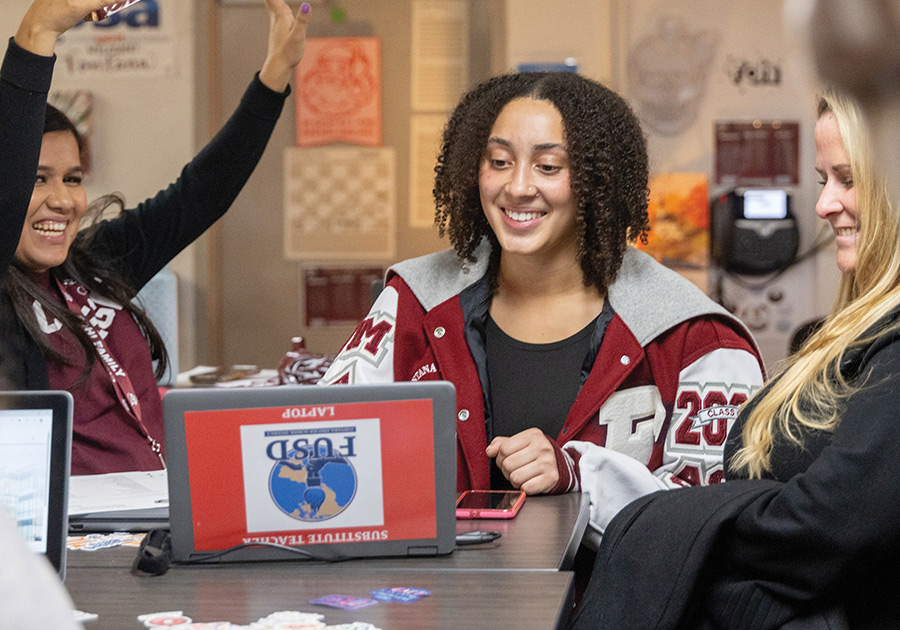
The initiative, launched at Fontana High School in 2016, has expanded access to higher education for local students and teaches important life skills while providing a memorable, celebratory moment for families. The district estimates that more than 10,000 students have participated over the years.
Fontana High was honored with a Golden Bell Award in 2025 in the Addressing Gaps in Student Outcomes category for its efforts that have resulted in increased rates in graduation, A-G requirement completion and Free Application for Federal Student Aid (FAFSA) completion.
As Fontana High Principal Joseph Malatesta explained, most students involved are first-generation college-goers, and many are also the first in their families to graduate high school.
The program “was a way to really help and push and build that college- and career-going culture,” Malatesta said, noting that navigating the application process for institutions in the University of California and California State University systems can be daunting and deter students from pursuing their education further.
The high school has been an AVID National Demonstration School for two decades, lauded for its “commitment to fostering a college-going culture, equipping students with essential skills for higher education and career success,” according to its website.
Malatesta said that spirit is the foundation of the program. “It shouldn’t be that you got into the AVID elective and therefore you have a better chance of getting to college or getting support with getting to college … We built off of that, knowing that what’s good for AVID kids is good for all,” Malatesta said of the expansion to support all students.
Malatesta added that the district wanted to create an event that recognized the years of work from students and staff that culminate in being able to apply for college.
“I know within our district, every high school has learned that it’s the pre-work that matters,” Malatesta said. “The month of October is what makes the day successful.”
Malatesta added that buy-in at Fontana High is schoolwide and starts before senior year. Beginning in junior year, as part of their English class, students learn about personal insight questions and other college essay prompts. As seniors, in September, they complete responses to common prompts as part of an assignment that receives peer and teacher feedback.
The supportive environment and commitment to removing barriers to student achievement goes beyond academics. For students who don’t receive a fee waiver, the district has set aside Local Control and Accountability Plan funding to offset application fees, usually covering up to one or two applications per individual.
On College Application Submit Day, Malatesta said that the teens and their loved ones come to campus to actually submit the applications and celebrate. At his campus, a tally of how many applications have been submitted is displayed and students walk a stage and have their names shown on screens. They host a reception with photo opportunities and provide students with special T-shirts and goodie bags.
This year at Fontana High, Malatesta recalled that “434 kids submitted over 2,500 college apps on that day, and we had just under 3,000 people come through — parents, family, friends — to celebrate with the seniors.” Although things kick off in the morning, Malatesta said their event goes until around 9 p.m. to try and accommodate different schedules.
Although not all students go into the process thinking of themselves as “college material,” when accepted, even if it’s not their first-choice school or they don’t plan to enroll, “they leave knowing that ‘I was college material,’” Malatesta said.
The experience also builds familiarity and confidence in filling out paperwork, which comes in handy as students enter the workforce and adult life.
Fontana High has seen its A-G completion increase from 42.8 percent in 2014–15 to 74.8 percent in 2024–25, graduation rate rise (93.7 percent in 2024–25) and college acceptance rate improve (93.1 percent in 2024–25 compared to 73 percent in 2014–15). The school had a college/career preparedness rate of 75.5 percent, according to the 2025 California School Dashboard. Most students also complete the FAFSA, according to Malatesta.
Malatesta acknowledged that the initiative takes work, but having the right group of dedicated and passionate people in place who believe “it’s our mission to open these doors” has made it a successful model that they now teach other schools and local educational agencies about.